


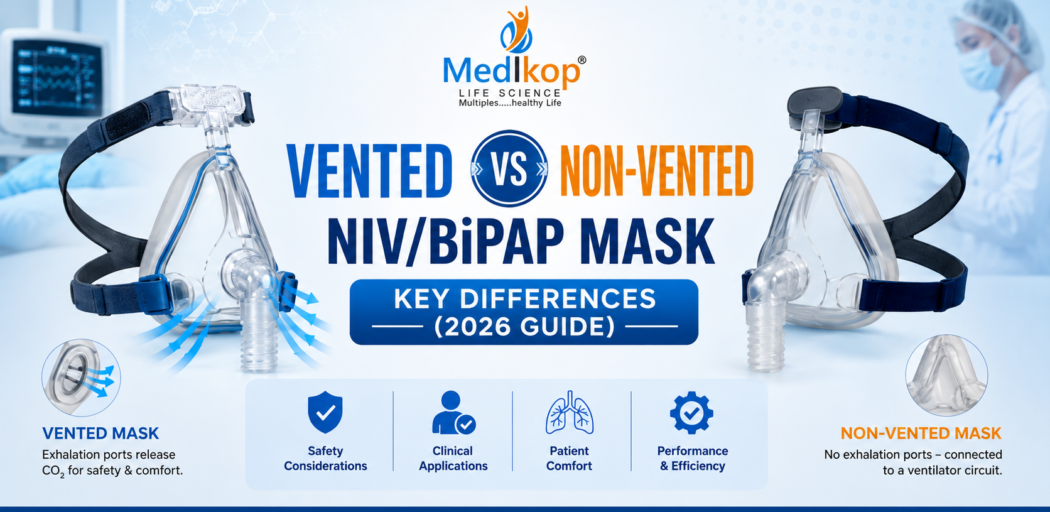
Vented vs Non-Vented NIV/BiPAP Mask: What’s the Difference and Which One Do You Need?
Quick answer: A vented mask has small holes built in. Air escapes right through the mask. It’s used on single-hose machines, like home BiPAP units. A non-vented mask has no holes. It needs a separate valve somewhere else in the tubing. It’s used on ICU ventilators with two hoses. These two masks are not interchangeable. Using the wrong one can cause a patient to re breathe CO2. That’s dangerous. Always match the mask to what your device maker or doctor tells you to use.
We manufacture NIV full face masks at Medikop. We make both types: vented (Windown, Inspire, Air force) and non-vented (Galaxy). This mix-up is common. Hospitals, distributors, and even caregivers get it wrong when re-ordering. It’s not just a compatibility problem. It’s a safety problem. Here’s how to tell the two apart, and how to pick the right one.
What Is a Vented Mask?
A vented mask has small holes. They’re built into the mask or its elbow piece. When the patient breathes out, air escapes through these holes. The mask itself acts as the exhale valve.
- Used with single-limb circuits. This is the one-hose setup on most home BiPAP, CPAP, and portable NIV machines.
- Steady airflow from the machine pushes air out through the vents. This clears CO2.
- Often has a clear or grey elbow. But this isn’t a fixed rule. Always check the mask packaging to be sure.
- Never tape or block the vent holes. Even if it’s to stop air leaks. Blocking them stops CO2 from escaping.
What Is a Non-Vented Mask?
A non-vented mask has no holes at all. It needs a separate exhale valve somewhere else in the circuit. This valve can be part of a two-hose ICU ventilator. Or it can be an add-on valve fitted into a single-hose circuit.
- Used with dual-limb circuits on ICU and hospital ventilators. One hose brings air in. A second hose carries exhaled air out.
- Can also work on some single-hose machines. But only if that circuit already has its own exhale valve fitted in the tubing. Never use a non-vented mask alone on a single-hose circuit with no valve.
- Often has a blue elbow. Again, this isn’t a guarantee. Always double-check.
- If used on a single-hose circuit, it needs an anti-asphyxiation valve. This valve opens on its own if the machine loses power. It lets the patient breathe room air instead.
Vented vs Non-Vented: Quick Comparison
| Vented Mask | Non-Vented Mask | |
|---|---|---|
| Exhale port | Built into the mask | Separate valve, not in the mask |
| Circuit type | Single-limb (one hose) | Dual-limb (two hoses), or single-limb with an added valve |
| Common devices | Home BiPAP, CPAP, portable NIV machines | ICU ventilators; some home setups with an inline valve |
| Usual elbow color | Clear or grey | Blue |
| Needs anti-asphyxiation valve? | No | Yes, if used on a single-hose circuit |
| Can you swap it for the other type? | No | No |
Why the Two Masks Are Not Interchangeable
Here’s the risk. If you use a non-vented mask on a single-hose circuit with no separate valve, exhaled CO2 has nowhere to go. The patient breathes it right back in. Studies on NIV masks point to this exact mistake as a top cause of dangerous CO2 re breathing. In a bad case, it can be fatal.
The reverse mistake is different but still bad. A vented mask on a two-hose ICU ventilator won’t cause re breathing. But it will confuse the ventilator’s pressure readings. This makes the therapy less effective.
So this is never a matter of taste. The mask type depends only on the circuit and machine it connects to. Always check your device’s manual. Or ask your doctor or biomedical engineer before you switch mask types.
Which One Do You Need?
- Using a home BiPAP, CPAP, or portable NIV machine with one hose? You need a vented mask.
- On an ICU ventilator with two hoses? You need a non-vented mask.
- Not sure which type your machine uses? Don’t guess. Check the manual. Or ask your clinical or biomedical team first.
- Ordering for a hospital in bulk? Always write “vented” or “non-vented” clearly on your order. “BiPAP mask” alone is not enough detail.
Frequently Asked Questions
Can I use a non-vented mask on my home BiPAP machine? Only if your circuit already has a separate exhale valve fitted in. If your home setup is just a plain single hose with no valve, don’t use a non-vented mask. Use a vented one instead.
How do I tell if my mask is vented or non-vented? Look closely. Vented masks have small visible holes or a perforated elbow. Non-vented masks have a fully sealed elbow with no holes. Color (clear/grey for vented, blue for non-vented) is common, but not every brand follows it. Check the packaging or product code to be sure.
What happens if I use the wrong mask type? On a single-hose circuit, a non-vented mask without its own valve can cause CO2 re breathing. This is a real safety risk. Stop using it right away. Switch to the correct mask for your device.
Can I tape over the vent holes to stop air blowing on my partner? No. Those holes are the only way CO2 escapes the mask. Blocking them, even partly, is not safe.
Do vented and non-vented masks come in different sizes? Yes, both come in small, medium, and large. Sizing has nothing to do with vent type.
The Bottom Line
Vented and non-vented masks both do the same job: clearing out CO2. But they do it in two different ways, built for two different circuits. Mixing them up isn’t a small mistake. It’s a safety issue. When in doubt, check your machine’s manual first.
At Medikop LifeScience, we make both types. That includes vented masks (Windown, Inspire, Air force) and non-vented masks (Galaxy). Hospitals and distributors can order either type from one trusted, quality-checked supplier. Get in touch with our team for specs or bulk and OEM orders.
Medical Disclaimer: This article is for general education only. It’s not a substitute for medical advice. Always confirm mask type, fit, and circuit compatibility with your doctor, respiratory therapist, or biomedical engineer, and check your device’s own instructions before use.