

Why So Many Indians Struggle to Breathe: Pollution, Tobacco, TB and What Care Looks Like Now
Short answer: India has no single respiratory problem. COPD, asthma, tuberculosis, pneumonia and occupational lung disease all exist side by side, and they’re driven by polluted air, tobacco, household smoke, dust at work, and infection. Most of these causes sit outside the hospital. For chronic diseases like COPD, by the time a patient reaches a hospital, the damage has usually been building for years.
How big is the problem?
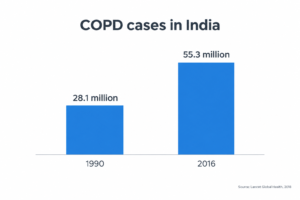
Honestly, the numbers are worse than most people guess, and they rose sharply over the past three decades.
In 1990, roughly 28 million Indians had COPD. By 2016, the India State-Level Disease Burden Initiative found that figure had nearly doubled, to about 55 million. Air pollution, tobacco and workplace exposure were among the main contributors.
One more number worth sitting with: the 2019 Global Burden of Disease study attributed 1.67 million deaths in India to air pollution that year, from smog outdoors and smoke indoors.
India also has the highest TB burden in the world, about a quarter of all global cases according to the WHO Global TB Report 2025. So many patients are dealing with infection, pollution and occupational risk at the same time.
What are the major respiratory diseases in India?
COPD (chronic obstructive pulmonary disease)
Narrows the airways until breathing out becomes hard work. Cigarettes are the classic cause, but not the only one here. Someone who cooked on a chulha for decades, or breathed mill dust every shift, can end up with it too. Outdoor pollution and repeated lung infections add to the damage.
Asthma
causes wheezing, coughing, chest tightness and breathlessness. Triggers differ from person to person: smoke, allergens, infections, weather changes, workplace exposure. It can usually be controlled, but only with a proper diagnosis and steady long-term treatment.
Tuberculosis (TB)
Is caused by Mycobacterium tuberculosis. Germs alone don’t explain it. Crowded homes, poor ventilation, under nutrition and late diagnosis do much of the work in spreading it. India’s National TB Elimination Programme (NTEP) has expanded screening, molecular testing, active case finding and treatment support.
Pneumonia and other respiratory infections
Hit infants, older adults, people with chronic lung disease and immunocompromised patients hardest. A bad infection can drop oxygen levels fast, and in the worst cases the lungs stop coping altogether. That’s not something to wait out at home.
Occupational lung disease
includes silicosis, coal workers’ pneumoconiosis, asbestosis and occupational asthma. Treatment helps, but cutting the exposure helps more.
Lung cancer
is strongly linked to tobacco. Air pollution and workplace exposures add to the risk.
How does air pollution affect the lungs?
PM2.5 particles are many times thinner than a strand of hair, so they slip past the nose and throat and settle deep in the lungs. Breathe them for years and the lungs pay for it.
The sources are familiar to anyone who lives in an Indian city: vehicle emissions, industry, coal and other combustion, construction, road dust, waste burning, crop burning and household fuels.
Exposure isn’t limited to a bad-air day in Delhi. It builds up through the commute, the workplace, the neighborhood and, for many families, the kitchen. That’s why air pollution is a public-health issue and not just an environmental one.
What is household air pollution?
Then there’s the kitchen. Cooking over wood, dung cakes or crop waste fills a room with smoke, and with poor ventilation the person nearest the stove breathes most of it. Usually that’s a woman, with small children close by.
India has widened access to cleaner cooking fuel, but access and everyday use aren’t the same thing. Cost, availability and habit still push some households back to firewood or dung cakes.
How does tobacco affect respiratory health?
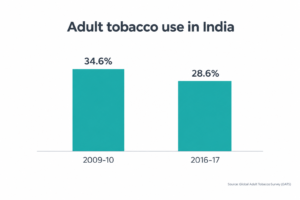
Tobacco is still one of the biggest preventable risks. In India it isn’t just cigarettes. Bidis, hookah, khaini, gutkha and zarda are all part of the picture.
Tobacco is behind a large share of COPD and lung cancer, and it feeds plenty of other diseases besides. According to the Global Adult Tobacco Survey, adult tobacco use fell from 34.6% in 2009-10 to 28.6% in 2016-17. That’s real progress, but more than a quarter of adults still use tobacco in some form. Prevention and quitting support remain central.
Is India’s healthcare system to blame for respiratory disease?
No, and it would be wrong to say so. Most causes start outside hospitals. Air pollution is an environmental exposure. Tobacco is tied to behaviour and commercial interests. Biomass smoke comes from household energy choices. Dust and chemicals are workplace hazards. Overcrowding and under nutrition are social conditions that help TB along.
Where healthcare does matter is after disease begins: early diagnosis, the right treatment, follow-up for chronic conditions, and, for severe cases, reliable access to oxygen, non-invasive ventilation (NIV) and other respiratory support.
What is India doing about it?
Two national programmes stand out.
The National Clean Air Programme (NCAP) works on air quality through monitoring and city-level action on transport, industry, road dust, construction and waste.
The National TB Elimination Programme (NTEP) focuses on finding and treating TB, with active case finding and more diagnostic capacity.
For COPD and asthma, primary care has a big role: spotting symptoms early, diagnosing, treating and following patients over the long term. Ideally, respiratory care shouldn’t start in the emergency department.
What happens when respiratory disease becomes severe?
Most people with COPD, asthma or pneumonia never need a ventilator. But when the lungs can’t get enough oxygen in or enough carbon dioxide out, a doctor has a few options:
- Oxygen therapy
- High-flow oxygen
- Non-invasive ventilation (NIV), including BiPAP and CPAP
- Invasive mechanical ventilation
The choice belongs to the clinician, based on how sick the patient really is.
Why does the NIV mask matter?
A ventilator is no use without a good mask. If it leaks, rubs or feels suffocating, patients pull it off, and then the therapy simply isn’t happening. Pressure sores and discomfort make it worse.
Fit, seal, comfort, adjustability and compatibility with the ventilator are what to look at when choosing an NIV interface.
Where does Medikop LifeScience fit in?
Medikop LifeScience is an Indian medical-device manufacturer that makes respiratory-care products, including NIV, BiPAP and CPAP masks and oxygen-therapy products.
Two of its NIV interfaces:
- AIRFORCE NIV/BiPAP mask: available in vented and non-vented versions, with adjustable headgear, a soft silicone cushion, a rotating elbow connector and an oxygen inlet.
- HELMET BiPAP mask: a transparent design with adjustable straps, an airtight seal and an oxygen inlet.
A mask only enters the picture after a doctor decides the patient needs breathing support. Not before. It doesn’t clean the air, cure COPD or stop TB.
What does the full respiratory-care journey look like?
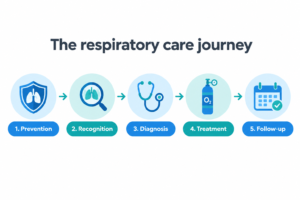
- Prevention: fewer people smoking, cleaner air, safer workplaces.
- Recognition: taking a persistent cough, breathlessness or repeated wheezing seriously.
- Diagnosis: COPD, asthma, TB and pneumonia have different causes and need different treatment.
- Treatment: including oxygen or ventilatory support for some patients.
- Long-term follow-up: chronic conditions need care after the crisis passes.
Public-health programmes, primary-care providers, hospitals, doctors, diagnostic labs, patients and device makers all have a part.
What does India need next?
- Prevention first: fewer people smoking and cleaner air to breathe.
- Earlier diagnosis: catch disease before it turns severe.
- Stronger primary care: COPD and asthma are lifelong, and patients shouldn’t only see a doctor when they land in the ER.
- Worker protection: better controls and monitoring for people exposed to dust, silica and chemicals.
- Faster TB detection: catch TB sooner and you protect the patient and everyone they live with.
- Dependable respiratory support: hospitals need oxygen and NIV equipment that’s actually available.
- Devices that work for real patients: judge equipment by how it feels to a frightened patient at 3 a.m., not by its spec sheet.
No single medicine, machine or programme will fix this. Cleaner air, tobacco control, safer workplaces, earlier diagnosis, better TB control and steadier chronic care all need to move together. That’s where a manufacturer like Medikop LifeScience comes in. It makes the masks and oxygen products clinicians reach for when a patient needs support, and nothing grander than that. The larger goal is fewer people reaching that point at all.
Frequently Asked Questions
What are the major respiratory diseases in India?
COPD, asthma, tuberculosis, pneumonia and other respiratory infections, occupational lung diseases and lung cancer.
What causes most lung disease in India?
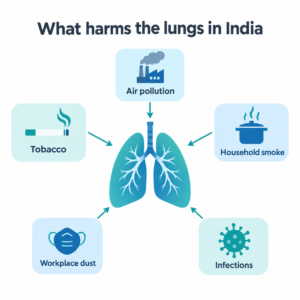
No single culprit. Pollution, tobacco, cooking smoke, dusty jobs and infections all pile on.
Does air pollution cause COPD?
It’s an important contributor. The India State-Level Disease Burden Initiative lists air pollution alongside tobacco and occupational risks as a driver of COPD burden.
Why does TB matter so much in India?
India has the highest TB burden in the world, about 25% of global cases, and spread is shaped by close contact, crowding, ventilation, nutrition and delayed diagnosis.
Can respiratory disease be prevented?
Often it can be reduced. Quit tobacco, stay out of heavy smog where you can, ventilate the kitchen, wear proper protection at work, and don’t ignore a cough that won’t go away.
When is NIV used?
For patients who need help breathing but don’t yet need a tube down the throat, and only when the doctor judges it suitable.
What does an NIV mask do?
The mask is the link between patient and machine. It carries the pressurised air in.
What respiratory products does Medikop LifeScience make?
Medikop makes NIV, CPAP and BiPAP masks and oxygen-therapy products for hospitals and clinics, including the AIRFORCE and HELMET interfaces.
About Medikop LifeScience
Medikop LifeScience is an India-based manufacturer of respiratory-care and related medical devices. It makes NIV, CPAP and BiPAP masks and oxygen-therapy products for hospitals and clinics.
MEDIKOP LIFESCIENCE GLOBAL PVT. LTD. medikoplifescience.in
Medical disclaimer: Weeks of coughing or getting breathless? See a doctor. This article is general information, not medical advice. Decisions about oxygen, NIV or invasive ventilation depend on the individual patient’s condition and should be made by a qualified healthcare professional.
References
- India State-Level Disease Burden Initiative CRD Collaborators. The burden of chronic respiratory diseases and their heterogeneity across the states of India: the Global Burden of Disease Study 1990-2016. The Lancet Global Health, 2018.
- Pandey A, et al. Health and economic impact of air pollution in the states of India: the Global Burden of Disease Study 2019. The Lancet Planetary Health, 2021.
- World Health Organization. Global Tuberculosis Report 2025. November 2025.
- Ministry of Health and Family Welfare, Government of India. Global Adult Tobacco Survey India (GATS 1: 2009-10; GATS 2: 2016-17).