

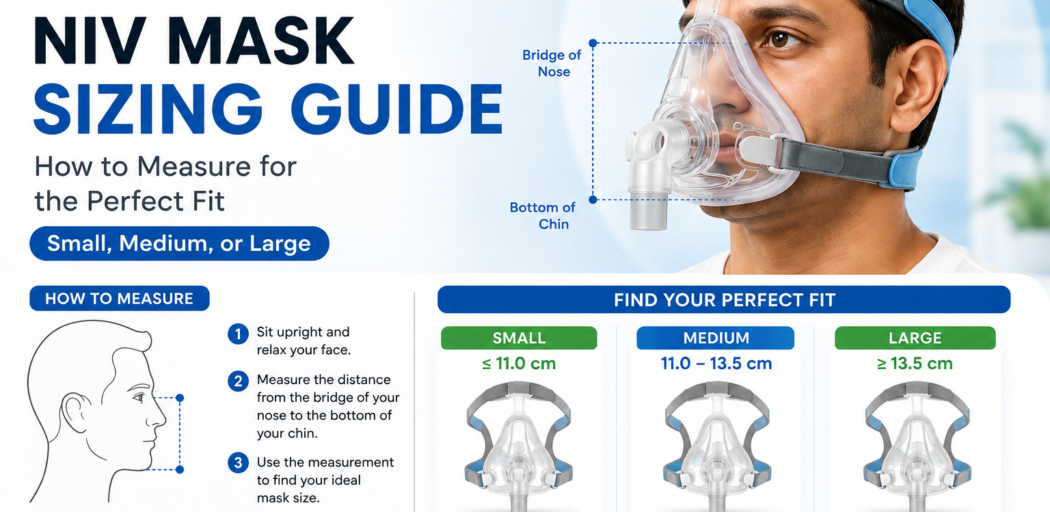
NIV Mask Sizing Guide: How to Measure for the Perfect Fit (Small, Medium, or Large)
If you’ve just been prescribed non-invasive ventilation, chances are nobody warned you about the one thing that makes or breaks the whole therapy: mask size. Not the brand. Not the price. The size. A mask that’s even slightly too big or too small can turn a life-saving treatment into a sleepless, frustrating ordeal — and it’s the single most common reason patients give up on NIV therapy in the first few weeks.
The good news is that getting the right NIV mask size isn’t complicated once you know what to measure and where. This guide walks you through it step by step, whether you’re fitting a mask for home BiPAP use or helping a hospital patient get set up correctly.
Why NIV Mask Size Matters More Than You Think
An NIV mask has one job: create a stable, comfortable seal against your face so pressurized air can be delivered without leaking. When the size is off, a few predictable things happen.
A mask that’s too small pulls tight across the bridge of the nose and cheeks, digs into the skin, and leaves red pressure marks within a couple of hours. A mask that’s too large, on the other hand, can’t form a proper seal no matter how much you tighten the headgear — air escapes around the edges, blows into your eyes, dries them out, and the machine has to work harder to compensate for the leak. Either way, you end up with disrupted sleep, skin breakdown, and therapy that isn’t actually delivering the pressure your doctor prescribed.
This is why sizing isn’t a “nice to have” step — it’s the difference between NIV therapy that works and one that gets abandoned.
Types of NIV Masks and How Sizing Differs
Before you measure anything, it helps to know which type of mask you’re fitting, because the measurement points aren’t the same for each.
Full face (oro-nasal) masks cover both the nose and mouth. These are the most commonly prescribed masks for BiPAP therapy, especially for people who breathe through their mouth at night or need higher pressure settings. Sizing here depends on the width of your face and the distance from the bridge of your nose to just below your lower lip.
Nasal masks sit over the nose only, sealing around the nostrils and the bridge of the nose. Sizing is based on nose width and the length from the bridge of the nose to the top of the upper lip.
Nasal pillow masks use small soft cushions that rest just inside the nostrils. These are sized by nostril spacing and typically come in fewer size variants since there’s less surface area to seal.
Hospital NIV masks (used in ICUs and for acute respiratory support) are often non-vented and need a tighter, more precise fit than home-use masks because there’s no separate exhalation port doing part of the work.
How to Measure Your Face for an NIV Mask
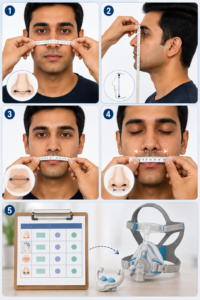
You don’t need any special equipment for this — a flexible measuring tape or a printed sizing gauge (most manufacturers, including Medikop, provide one with their masks) will do the job. Here’s how to take the measurements that actually matter.
Step 1: Measure nose width. Place the tape horizontally across the widest part of your nose, at the flare of the nostrils. This number determines whether a nasal or nasal-pillow mask will seal properly.
Step 2: Measure face length (bridge of nose to chin). For full face masks, measure vertically from the bridge of your nose — roughly where your glasses would rest — down to the point just below your lower lip, above the chin. This is the measurement most sizing charts are built around.
Step 3: Measure mouth width. For full face masks, also check the width of your mouth at its widest point when relaxed (not stretched). A mask that’s narrower than your natural mouth width will feel restrictive within minutes.
Step 4: Check nostril spacing (for nasal pillows only). Measure the distance between the outer edges of your nostrils. Nasal pillow sizes are usually more sensitive to this than to overall face size.
Step 5: Compare against the manufacturer’s sizing chart. Every brand’s cushion geometry is slightly different, so always check the specific sizing chart for the mask you’re buying rather than assuming your “usual” size will carry over from one brand to another.
General NIV Mask Sizing Reference
Actual size boundaries vary slightly by manufacturer and mask model, so treat this as a general guide rather than a substitute for the specific sizing card that comes with your mask.
| Size | Typical Face/Nose Width | Best For |
|---|---|---|
| Small | Narrower face, smaller nose bridge | Petite adults, some teenagers |
| Medium | Average adult face width | Most adult users — the most commonly prescribed size |
| Large | Broader face, wider nose bridge | Larger-framed adults |
| Pediatric | Significantly smaller face structure | Children, based on age and facial development |
A quick note on pediatric sizing: children’s faces aren’t just scaled-down adult faces — the proportions are different, particularly the nose bridge and chin length. Never size a child into the smallest adult mask “because it’s close enough.” A properly designed pediatric mask will always fit better and seal more reliably.
Signs Your NIV Mask Doesn’t Fit Right
Even with careful measuring, it’s worth checking these signs during the first few nights of use:
- Red marks or indentations on your face that don’t fade within 20–30 minutes of removing the mask
- A hissing or whistling sound coming from the mask edges rather than the vent
- Air blowing directly into your eyes
- The machine repeatedly flagging a “high leak” warning
- Difficulty falling asleep because the mask feels tight, loose, or unstable
If you notice any of these, don’t just tighten the headgear further — that usually makes leaks and pressure marks worse, not better. Try the next size up or down instead, and recheck your measurements.
Getting It Right the First Time
If you’re sourcing NIV or BiPAP masks for a hospital, clinic, or homecare setup, buying from a manufacturer that offers a genuine range of sizes — including pediatric options — makes this whole process far easier than trying to make one size work for every patient. At Medikop Life Science, our NIV and BiPAP full face masks are available across small, medium, and large fittings precisely because we know one size never really fits all.
Frequently Asked Questions
How do I know if my NIV mask is too small? The clearest signs are pressure marks that don’t fade, tightness across the nose bridge, and skin irritation after a few hours of use. If you’re constantly adjusting the straps to find comfort, the mask is likely undersized.
Can I use an adult NIV mask on a teenager? It depends on facial size rather than age alone. Many teenagers fit into a small adult mask, but younger or smaller-framed children need a dedicated pediatric mask for a proper seal.
Do all NIV mask brands use the same sizing chart? No. Cushion shape and sizing vary by manufacturer, so always check the specific chart provided with your mask rather than assuming your size from one brand applies to another.
How often should I recheck my mask size? It’s worth rechecking if you gain or lose noticeable weight, after any facial surgery or dental work, or if you start experiencing new leaks or discomfort with a mask that used to fit well.
What should I do if I’m between two sizes? When measurements fall between two sizes, most clinicians recommend sizing down for a tighter seal on nasal and nasal pillow masks, and sizing up for full face masks to avoid pressure on the bridge of the nose. When in doubt, ask your homecare provider for a trial fitting.